
Forever Young-ish
Aging may be more flexible than humanity assumed for thousands of years.

For most of human history, medicine has focused on slowing decline.
Doctors learned how to treat infections, repair injuries, replace failing joints, and extend survival after disease. But aging itself remained largely outside the boundaries of medicine: an inevitable process that every human body experienced and no one seriously expected to reverse.
That assumption is beginning to change.
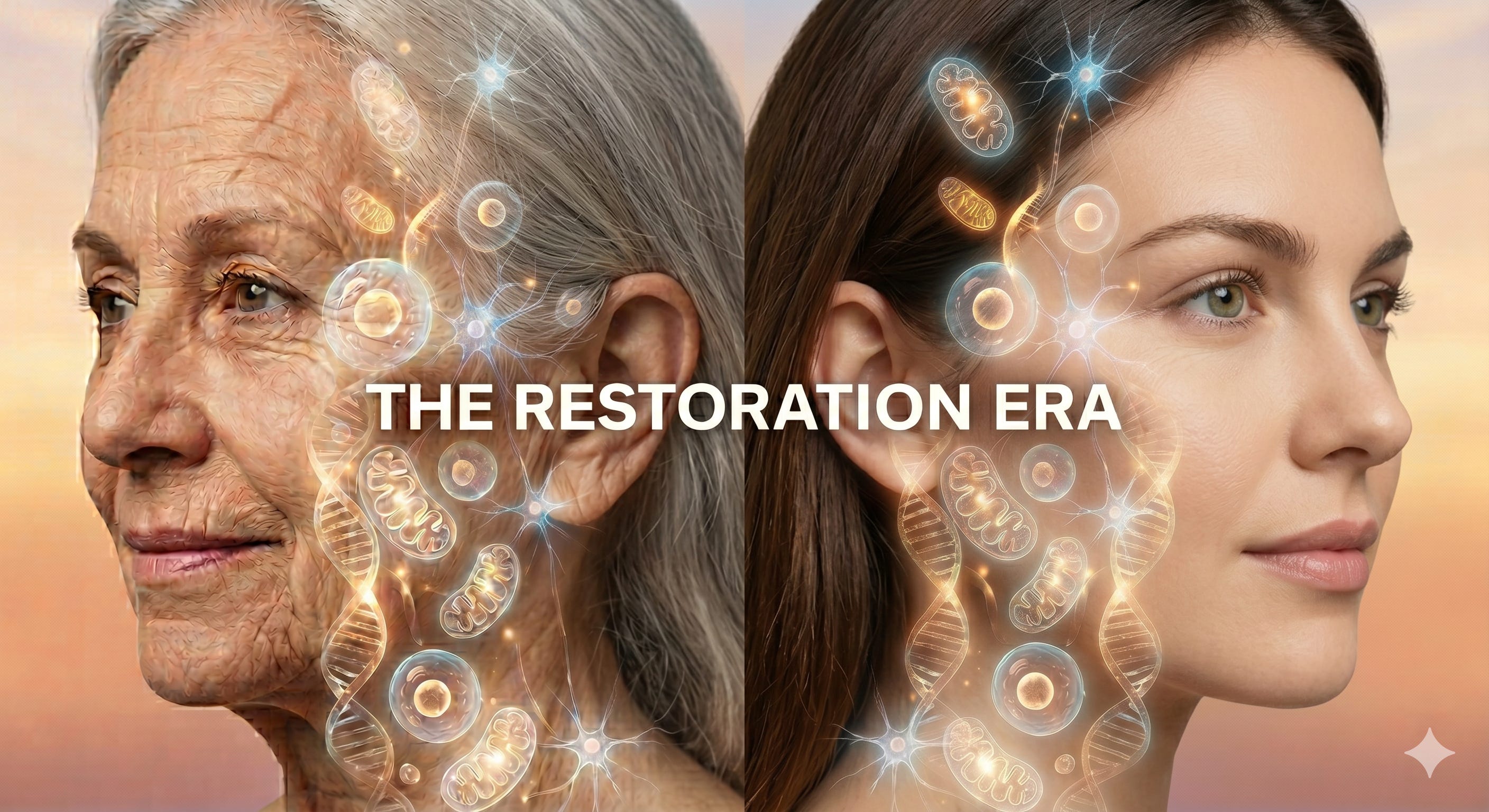
This week, the conversation around cellular rejuvenation accelerated again as new advances in regenerative medicine, organ restoration, epigenetic reprogramming, and longevity science continued to move from theory toward practical application. Researchers are now exploring ways to restore tissue function, rejuvenate aging cells, regenerate organs, and help biological systems recover from damage that was once considered permanent.
Not immortality.
Not science fiction.
But something potentially more meaningful: a longer, healthier, more vibrant human life.
A growing number of scientists now believe aging may be more flexible than humanity assumed for thousands of years. The question is no longer simply whether people can live longer. It is whether we can extend the number of years people remain healthy, independent, cognitively sharp, and physically resilient.
That shift changes the entire framework of medicine.
For years, longevity science suffered from terrible branding. “Anti-aging” often sounded cosmetic, unrealistic, or vaguely Silicon Valley. But the emerging field of regenerative biology feels much more grounded and profoundly human. Researchers are increasingly focused on preserving mobility, restoring immune function, reducing inflammation, protecting cognition, and helping the body repair itself more effectively over time.
In other words, the goal is not to escape humanity.
It is to preserve it longer.
The most exciting part of this moment is not any single breakthrough. It is the convergence happening across multiple fields simultaneously. Scientists studying stem cells, epigenetics, senescence pathways, organ engineering, AI-driven drug discovery, and regenerative therapies are increasingly arriving at the same conclusion: biological systems may be far more adaptable and repairable than we once believed.
That realization has implications far beyond healthcare.
If cellular rejuvenation therapies succeed even partially, they could reshape industries ranging from insurance and pharmaceuticals to agriculture, wellness, workforce participation, and consumer technology. A healthier seventy-five-year-old in 2045 may live more like today’s fifty-year-old, fundamentally changing assumptions around retirement, education, travel, housing, and productivity.
The economic implications alone are staggering.
One emerging sector is likely to be regenerative healthcare infrastructure. Today’s wellness clinics and medical spas may evolve into sophisticated longevity centers combining genomic diagnostics, biological age testing, personalized therapies, regenerative treatments, and continuous health monitoring. The annual physical may someday look less like a routine checkup and more like a systems diagnostic for the human body.
Organ engineering and tissue manufacturing may become equally transformative. Researchers are already developing organoids, bioprinted tissues, stem-cell therapies, and gene-edited transplant systems designed to address global shortages of donor organs. Entire industries may emerge around tissue fabrication, organ preservation, regenerative logistics, and cellular manufacturing.
Biology itself is becoming a platform technology.
Insurance and finance may evolve alongside it. If biological aging becomes measurable and increasingly modifiable, insurers may eventually focus less on chronological age and more on markers tied to inflammation, metabolic health, recovery capacity, and cognitive resilience. Employer-sponsored longevity programs and regenerative healthcare benefits could eventually become as common as retirement plans are today.
Food systems are also beginning to intersect with the longevity economy. Genomics companies are developing crops designed for improved nutritional density, microbiome support, reduced inflammatory impact, and climate resilience. The distinction between healthcare and food may continue to blur as consumers increasingly prioritize products that support long-term vitality rather than simply calorie consumption.
The cultural implications may be even bigger than the economic ones.
For centuries, aging has largely been framed as decline. But regenerative biology introduces a more hopeful possibility: that the body retains meaningful capacity for renewal far later into life than we once imagined. Scientists are discovering that cells can recover function, tissues can regenerate under the right conditions, and biological age may not always align perfectly with chronological age.
The first generation to biologically age more slowly may already be alive.
Of course, there are still enormous scientific and ethical challenges ahead. Many therapies will fail. Some technologies will prove too expensive or too difficult to scale broadly. Regulators, healthcare systems, and societies will need to navigate difficult questions around access, affordability, and equity.
But the overall direction is becoming increasingly difficult to ignore.
Medicine once helped us survive longer. The next era of medicine may help us remain more fully alive while we are here.
That may ultimately become one of the defining stories of the twenty-first century—not because humans stop aging entirely, but because aging itself becomes more manageable, more treatable, and more flexible than previous generations ever imagined possible.
The most important breakthrough may not be immortality.
It may simply be giving millions of people more healthy years with the people they love.
References & Further Reading
Altos Labs
https://altoslabs.com
NewLimit
https://www.newlimit.com
Retro Biosciences
https://www.retrobiosciences.com
Turn Biotechnologies
https://turn.bio
Rejuvenate Bio
https://www.rejuvenatebio.com
Wake Forest Institute for Regenerative Medicine
https://www.wakehealth.edu/research/institutes-and-centers/wake-forest-institute-for-regenerative-medicine
Buck Institute for Research on Aging
https://www.buckinstitute.org
Hevolution Foundation
https://www.hevolution.com
American Federation for Aging Research
https://www.afar.org
Nature Biotechnology
https://www.nature.com/nbt
STAT News
https://www.statnews.com
Longevity Technology
https://longevity.technology